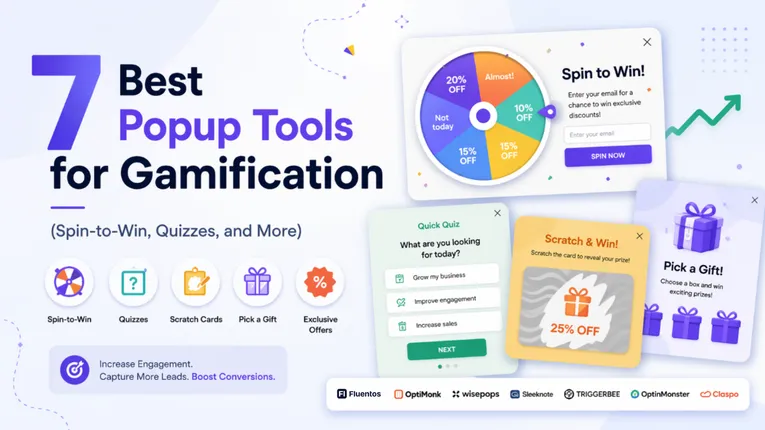
7 Best Popup Tools for Gamification
Most website visitors have learned to ignore traditional popups. Static email forms and generic discount banners often blend into the background, especially when every site uses the same tactics.
That is why gamification has become such a popular approach for onsite engagement. Interactive popup campaigns like quizzes, spin-to-win offers, scratch cards, and reward-based experiences give visitors a reason to participate instead of simply dismissing the message.
But the best popup tools for gamification are no longer just about spinning wheels or flashy effects. More businesses are looking for platforms that combine gamification with behavioral targeting, personalization, CRM integrations, and lightweight website performance.
According to research published in the Harvard Business Review, organizations that successfully implement gamification techniques report a 48 percent improvement in engagement.
This guide breaks down the top tools, what each one offers, and how they compare so you can choose the right fit for your business. If you are still deciding on a format rather than a platform, start with our guide to gamified popups and how to set them up.
What Are Gamified Popups and Why Do They Work?
Gamified popups use interactive mechanics to encourage visitors to engage with a website. Instead of presenting a standard form, they create a small experience that encourages participation before asking for an email signup, action, or conversion.
Common gamification popup formats include:
- Spin-to-win wheels
- Quizzes
- Scratch cards
- Mystery offers
- Pick-a-gift campaigns
- Reward reveals
- Interactive surveys
The reason these campaigns perform so well is because they shift the interaction from passive to active. Visitors are no longer simply being shown a message. They are participating in something.
Gamification campaigns can also help businesses collect zero-party data, meaning information users intentionally share themselves. This is especially valuable for segmentation, email personalization, and CRM workflows.
Gamification Is Evolving Beyond Spin-to-Win Popups
The earliest generation of gamified popups focused heavily on discount mechanics. Spin-to-win wheels and scratch cards were designed primarily to increase email signups with incentive-driven offers.
While these formats still work well, many businesses are now moving toward more contextual onsite engagement strategies.
Instead of showing the same popup to every visitor, newer popup platforms allow campaigns to react to:
- visitor behavior
- browsing activity
- traffic source
- location
- returning visits
- audience segmentation
- CRM data
- purchase intent
This shift is changing how businesses approach gamification entirely. Interactive campaigns are becoming less about “games for the sake of games” and more about creating relevant onsite experiences that support engagement, lead generation, and personalization together.
1. Fluentos
Fluentos approaches gamification as part of a broader onsite engagement strategy rather than treating it as a standalone popup feature.
Instead of relying only on static spin-to-win mechanics, Fluentos combines gamification with behavior-based triggers, audience targeting, personalization, localization, and CRM segmentation. This allows popup campaigns to react more dynamically to what visitors are actually doing on the website.
For example, quizzes, reward-based offers, or interactive popups can trigger differently for returning visitors, traffic sources, specific regions, or high-intent browsing behavior. Campaign interactions can also feed directly into CRM and automation workflows to support better segmentation and follow-up campaigns.
Fluentos also places a strong emphasis on lightweight performance and privacy-conscious campaign delivery, which is often overlooked in many traditional popup tools.
Worth considering if
You want gamification to support a broader personalization, segmentation, and lead generation strategy instead of running isolated popup campaigns.
2. OptiMonk
OptiMonk is one of the most widely used onsite personalization and popup platforms available. It supports a wide range of traditional gamification formats, including spin-to-win wheels, scratch cards, mystery offers, and pick-a-gift campaigns.
The platform also includes A/B testing, targeting rules, cart-based segmentation, and retargeting functionality that make it particularly useful for ecommerce brands.
Similar to Fluentos, one advantage is that gamification features are included across paid plans without requiring a separate upgrade.
Worth considering if
You want a large ecommerce-focused popup platform with strong traditional gamification templates and segmentation tools.
3. Wisepops
Wisepops combines popup campaigns, banners, embedded messages, and onsite targeting into one engagement platform.
Rather than focusing heavily on traditional gamification mechanics, Wisepops leans more into flexible onsite messaging and interactive engagement campaigns like quizzes and surveys.
Its visual editor and targeting system make it particularly appealing for teams that want more control over audience segmentation and personalization without relying heavily on developers.
Worth considering if
You want flexible onsite engagement tools that combine personalization, targeting, and lighter gamification experiences.
4. Sleeknote
Sleeknote is known for advanced audience segmentation and e-commerce targeting capabilities. The platform supports multiple gamification formats alongside strong targeting rules based on cart value, traffic source, shopping behavior, and device type.
Its biggest strength is precision segmentation. Campaigns can behave very differently depending on visitor conditions and audience rules.
However, gamification features are only available on higher-tier plans.
Worth considering if
You want gamification campaigns that can be tailored to specific visitor behaviors, traffic sources, or customer segments.
5. Triggerbee
Triggerbee offers one of the largest collections of traditional gamification formats available in a popup platform.
Beyond spin-to-win wheels and quizzes, the platform also includes memory games, scratch-and-reveal campaigns, calendar mechanics, and daily reward campaigns.
It also includes advanced analytics and visitor identity features that go beyond basic popup reporting.
Worth considering if
You want the broadest collection of traditional gamification mechanics and interactive campaign formats.
6. OptinMonster
OptinMonster has been a long-standing popup and lead generation platform, especially popular among WordPress sites, publishers, blogs, and SaaS businesses.
Its gamification capabilities are simpler than some competitors, primarily focusing on spin-to-win campaigns and exit-intent lead capture.
Where it performs best is combining popup targeting with content-driven lead generation strategies.
Worth considering if
You run a content-heavy or SaaS-focused website and want a familiar lead generation platform with basic gamification features.
7. Claspo
Claspo offers one of the largest template libraries in this category, with over 1,000 options. Gamified popup types, including spin-to-win wheels, scratch cards, and pick-a-gift formats, are supported and available in the template library. The platform focuses on helping teams launch campaigns quickly through pre-built templates and simple setup. Claspo has also published research showing strong conversion gains from gamified experiences, particularly when rewards feel meaningful and relevant to visitors.
Worth considering if
You want a large template library and easy access to common gamification formats without a significant upfront investment.
Why Lightweight Gamification Matters
Many popup tools focus heavily on visual effects and animations, but fewer discuss the impact these campaigns can have on website performance.
Heavy scripts, excessive animations, and layered third-party tracking can negatively affect:
- page speed
- mobile usability
- Core Web Vitals
- user experience
- bounce rates
Lightweight gamification campaigns help reduce unnecessary overhead while still creating engaging interactions.
This is one reason newer platforms like Fluentos are focusing more heavily on performance-conscious campaign delivery alongside personalization and gamification features.
Gamification and First-Party Data Collection
Gamified popup campaigns are increasingly being used for more than just discounts.
Interactive quizzes, surveys, and engagement flows allow businesses to collect first-party and zero-party data that can improve:
- CRM segmentation
- email personalization
- audience targeting
- automated workflows
- product recommendations
Platforms that connect popup interactions directly into CRM and marketing systems often create significantly more long-term value than standalone email capture tools.
Best Practices for Gamified Popup Campaigns
Even the best popup tools for gamification still depend heavily on how campaigns are deployed.
Use behavior-based triggers
Popup campaigns perform better when tied to user behavior rather than immediately loading on page entry.
Keep experiences relevant
Gamification works best when the reward or interaction matches visitor intent.
Avoid overly aggressive campaigns
Visitors should always be able to dismiss campaigns easily without frustration.
Use quiz data for segmentation
Quiz campaigns can become valuable sources of customer insights and personalization opportunities.
Limit frequency
Showing the same popup repeatedly reduces engagement over time.
Connect campaigns to your CRM
The real value often comes after the popup interaction through segmentation and follow-up automation.
Gamification Works Best When It Feels Relevant
The most effective gamification campaigns are not necessarily the loudest or most visually complex ones. They are the campaigns that feel connected to the visitor experience.
As popup strategies evolve, more businesses are moving beyond static discount wheels and toward behavior-based engagement, personalization, and interactive experiences that support long-term customer relationships.
The best popup tools for gamification are increasingly the ones that combine engagement, targeting, personalization, CRM integration, and lightweight performance into a single system rather than treating gamification as an isolated feature.
Ready to Turn Website Visitors Into Engaged Subscribers?
Gamified popup campaigns can help increase engagement, improve lead generation, and create more interactive onsite experiences when paired with smart targeting and personalization strategies.
Fluentos combines gamification, behavior-based triggers, localization, CRM integrations, and lightweight popup performance into one platform designed for modern onsite engagement.
FAQs About Gamified Popup Tools
How do gamified popups differ from traditional email popups?
Gamified popups add interactive elements like quizzes, wheels, or scratch cards, turning a passive signup into an active experience. Traditional popups simply ask for an email in exchange for a discount or offer.
Do gamified popups slow down a website?
Most modern popup tools are lightweight and load asynchronously, so they have minimal impact on site speed when configured properly. Poor implementation or too many scripts can still affect performance.
Can gamified popups be used without offering discounts?
Yes. Many businesses use gamification for engagement, segmentation, or education instead of discounts. Quizzes and interactive flows can guide users to products or capture insights without offering a price incentive.
What type of gamified popup converts best?
Spin-to-win typically performs best for quick email capture, while quizzes tend to generate higher-quality leads because they collect intent and preference data.
How often should gamified popups appear to visitors?
They should not appear on every visit. Most high-performing setups use frequency caps such as once per user per session or once every few days to avoid fatigue and maintain engagement.