Black Week 2026: What Fluentos Data Says Retailers Should Fix Before November
Most Black Week popups are built in the second week of November, cloned from last year, and switched on the Monday before Black Friday. Then everyone watches the dashboard and hopes.
The decisions that decide how Black Week goes, which visitors see which campaign, when the signup form opens, what the teaser looks like on a phone, whether the buttons are even being counted, are all made before November. Most of them are made on instinct, because nobody has looked at what actually happened last time.
So we looked. Fluentos runs onsite campaigns for multi-market European retailers, and the platform recorded what those campaigns did across October, November and December 2025. This post is what that data says, pooled across every retailer in the sample, and what we would change before this year's Black Week.
How We Looked at the Data
Everything below comes from campaigns delivered through Fluentos between October and December 2025, plus November 2024 where the history reaches that far. The sites are multi-market fashion and lifestyle retailers, and in November 2025 they recorded more than 16 million sessions between them, up from 12.6 million in October.
Three caveats, because a number without its limits is a number you should not trust. Every figure is pooled across all retailers in the sample or given as a range across sites; no customer is named and no figure describes a single store. History from 2025 is stored as monthly totals, so we can compare October with November but cannot see the Friday itself. And the sample is mostly fashion, so if you sell electronics or furniture, read the direction of each finding rather than the decimals.
November Is Bigger Than Your Plan Assumes
Pooled sessions rose 28% from October to November 2025. On the largest multi-market sites individually the lift ranged from 17% to 48%, and year on year the largest sites did between 51% and 65% more November sessions than the year before.
The obvious consequence is that any mistake in a campaign costs a good deal more in November than in October, so checking your Black Week setup on the test environment in October, before the offer goes anywhere near the live site, is cheap insurance.
The less obvious one is what the extra volume is worth. The always-on signup forms in the sample ran at a little under 1% in November, no better than in October, while the dedicated Black Week forms on the same sites ran at roughly double that. Part of the gap is that the Black Week forms had priority and reached visitors first, so the everyday forms were left with the people who had already said no. But the direction is consistent across the sample: a store that leaves its everyday popup running through November still gets more signups, because there is more traffic, and it gives up the doubled rate that a campaign built for the week earned.
Black Friday Is Not the Peak for Signups
The clearest pattern in the data is when signup forms work. Pooling every form shown to visitors the CRM did not recognise, and grouping them by what the campaign promised, gives a curve that peaks before the Friday.
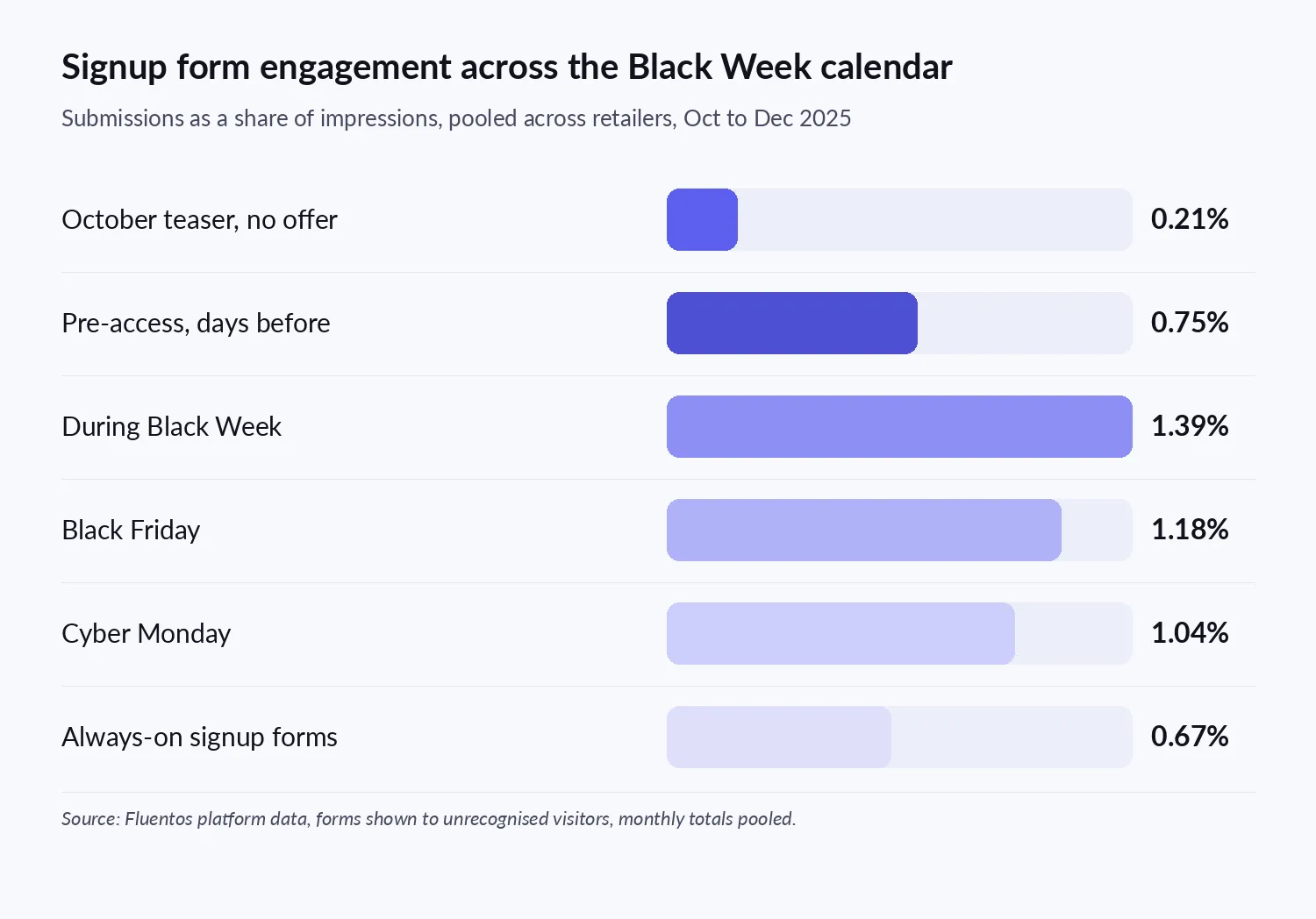
October forms announcing that Black Week was coming, with nothing to claim yet, ran at 0.21%, worse than the always-on account forms at 0.67%. Pre-access forms in the days before the event ran at 0.75%. Forms shown during Black Week itself ran at 1.39%. Then Black Friday forms dropped to 1.18%, and Cyber Monday forms to 1.04%.
The lesson is not simply "start early". Teasing Black Week in October with nothing to claim did worse than the plain account form running beside it. A form that offers something concrete, early access or a code that goes live on a date, did well in the days before the event and peaked during the week. The most likely reading is that by the Friday, the shoppers who were going to sign up already had, and the rest were there to buy; part of the drop may also be that the Friday forms ran behind the Black Week forms in priority and met visitors who had already declined once. Either way, if your calendar has one big signup push scheduled for Black Friday, move it forward by a week and give it something to promise.
Build each stage as its own campaign rather than editing one campaign's copy as the week goes on. A visitor who closes the pre-access form is held back from that campaign by its re-open rules, so if the Black Friday offer is the same campaign with new wording, the people who dismissed it a week earlier never see it. A new campaign for each event, pre-access, Black Week, Black Friday and Cyber Monday, reaches those visitors again with a fresh reason to look, and gives you a clean report per event instead of one blurred number.
Show Known Visitors Something Different
This is where the largest gap in the whole dataset sits. Retailers who ran their Black Week, Singles Day and Cyber Monday offers as two campaigns, a code reveal for visitors their CRM recognised as subscribers or members and a signup form for everyone else, show the pattern most clearly. Pooled across those campaigns, recognised visitors acted on the campaign 4.8% of the time. Anonymous visitors submitted the signup version 1.1% of the time.
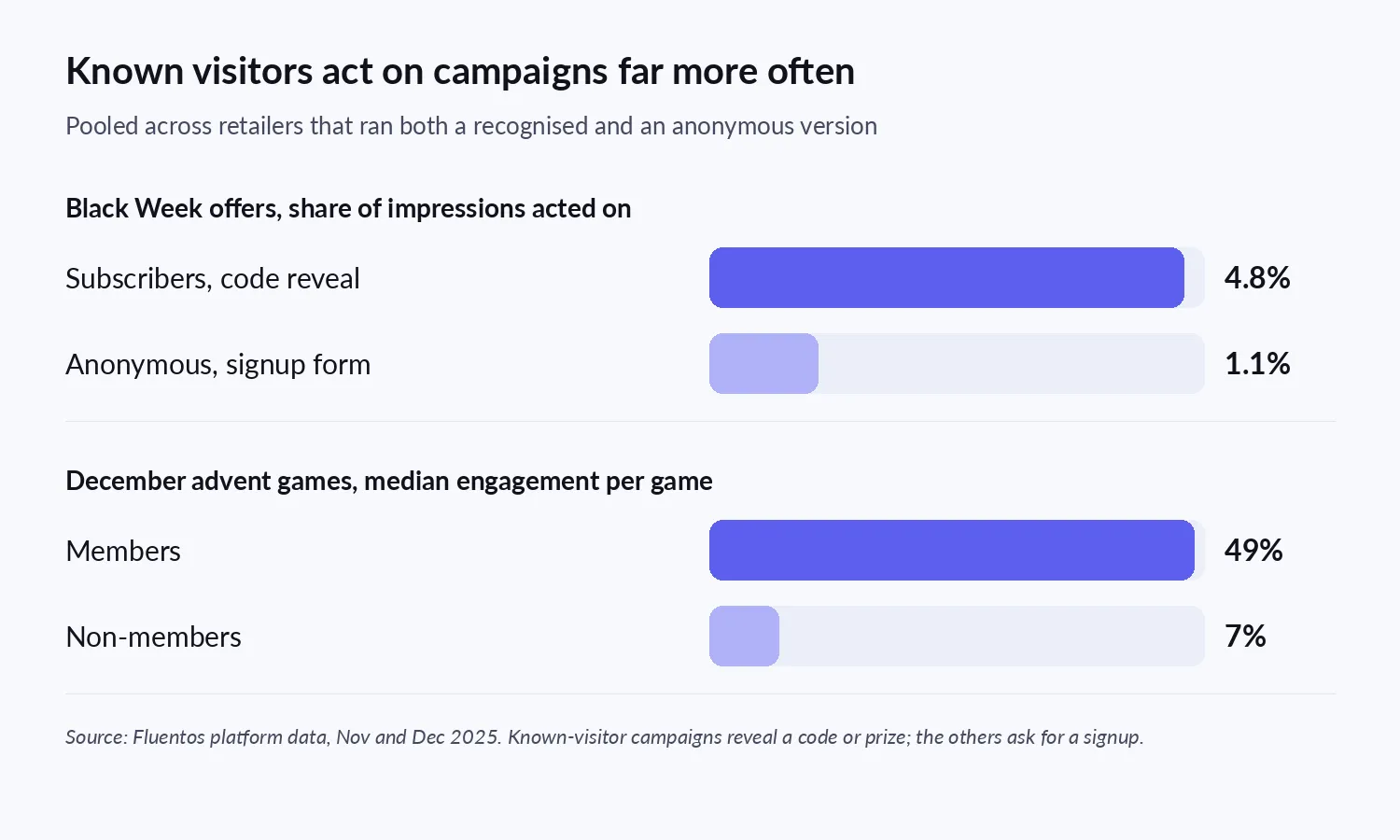
December makes the gap wider still. Across the daily advent games in the sample, the member-only versions had a median engagement of 49%, with a range from 22% to 75%. The same games shown to non-members had a median of 7%, ranging from 2.5% to 15%.
Part of that is that a click is easier than a form. But that is exactly the point. A subscriber does not need to give you their email again, and asking them to is why so many Black Week popups are closed on reflex by the people most likely to buy. Fluentos resolves the visitor against your CRM audience at the edge, so a Klaviyo, Voyado or ActiveCampaign segment can decide which campaign opens, with no email required. We covered the mechanics in our post on email list growth popups. The Black Week version is simply: known visitors get the code, unknown visitors get the form.
Once that split exists, the same audience data lets you go a level further, because the segment decides the message and the page decides the moment. The lowest loyalty tier gets a game that starts them earning points. The top tier gets a thank-you gift with no purchase condition, since a discount is not what keeps them. Members who have not bought in ninety days get a quiet reminder that their points expire. And the same free-delivery banner that everyone else sees can greet a logged-in member by name with an offer that counts double this week. None of this needs a new campaign format, only a different audience rule on a campaign you already run.
Name the Thing and the Deadline
Across the November 2024 history, discount banners that named a category, a percentage off outerwear, dresses or knitwear, clicked at 9.2% pooled. Banners promising a blanket sale, a percentage off everything or an "up to" figure, ran at 7.9%. The always-on signup-for-a-discount teasers shown across the same month ran at 3.2%. One caution on reading that: the category banners were also shown to far fewer, more targeted visitors than the blanket ones, and a narrowly targeted campaign will post a higher rate on targeting alone. The gap is real but smaller than the wording suggests.
The countdowns in 2025 point the same way. Pooled across Black Week, Singles Day and Cyber Monday countdowns, the click rate was 5.1%, and the Singles Day and Cyber Monday countdowns individually beat the broader Black Week ones. On the smaller sites, banners for a single day, shown to about 2% of sessions, clicked at about 3%, while broad banners running across the whole of Black Week and shown to a third of sessions ran at about 1%. Reach and rate trade off, so the fair comparison is total clicks, and on that measure the broad banners still won on volume. The narrow ones won on relevance.
A deadline attached to a specific thing is a reason to act. "Sale" is wallpaper. A single all-of-November banner left running across Singles Day, Black Week and Cyber Monday flattens the urgency that makes each of them work. If you are unsure whether the discount itself is worth running, we have written separately on when special offers pay for themselves.
Black Week Happens on Phones
Mobile accounted for 76% to 92% of Black Week campaign impressions across the sites where the split is recorded. That would be unremarkable if the rates were level. They are not. Pooled across the Black Week signup forms, mobile engaged at 1.39% against 0.92% on desktop. Pooled across the Black Week banners and countdowns, mobile clicked at 4.8% against 3.1% on desktop.
More than one campaign in the sample was configured to show on desktop only, presumably a leftover from a design review done on a laptop. On a week when four in five visitors arrive on a phone, that setting quietly removes most of the audience.
In Fluentos the desktop design is the base and mobile inherits from it, so design the desktop version to match what mobile needs as closely as possible: one column, short copy, a large tap target, nothing that only works with a cursor. Then check the teaser on a real phone, override the few components that need their own mobile wording, and be careful with anything that relies on exit intent, which does not exist on a touchscreen. We set out why in our post on exit intent on mobile.
The Teaser Sets the Ceiling
Most Black Week campaigns in the sample open as a collapsed teaser the visitor expands. The data shows a two-stage funnel, and most teams only look at the second stage.
Expand rates on the Black Week teasers ranged from 1.6% to 15.7%. Once expanded, the forms behind them engaged between 18% and 66% of the people who opened them. That second figure flatters the form, because the people who expand a teaser are the ones who already wanted what it offered. What it does show is where the visitors are lost: at the teaser, not the form. The difference between the best and worst teaser in the sample was a factor of ten.
Report both numbers. If expand rate is low, the fix is the teaser's size, copy, colour and position, not the form. If expand rate is fine and submissions are low, the form is the problem. Fluentos reports the teaser and the expanded step separately for exactly this reason.
There is also a third option that sidesteps the expand rate entirely. Fluentos can open the campaign expanded on arrival, with no delay, and minify it to the teaser when the visitor closes it instead of removing it from the page. Everyone sees the offer once, and the teaser stays available for the rest of the visit for anyone who changes their mind. That solves the visibility problem completely and moves the question to how many people close it unread, because an auto-expanded teaser is still a full popup with a graceful exit, and spends the same interruption budget. Run it as an A/B test against the passive teaser during the week rather than switching it on for everyone.
December Belongs to Games
Once Cyber Monday passes, the highest-engagement campaigns in the dataset are not discounts at all. Standalone scratch cards and spin-the-wheel campaigns shown in December engaged 18% to 22% of the visitors who saw them, with click rates above 25%. Advent calendar teasers clicked between 4.7% and 11.8%, and the daily games behind them ran at the member and non-member rates above.
December traffic in the sample stayed close to November's, discounts are exhausted by then, and a game gives shoppers a reason to engage that is not another 20% off. The plain December signup forms in the sample ran at 0.66%, back to the everyday rate, while the games ran many times higher. A game asks for a tap where a form asks for an email, and several of the games were member-only, so the two rates are not the same currency. But the games also collected data and handed out codes, and they did it on the same traffic that was ignoring the forms. If you have not built one yet, our guide to gamified popups covers the formats and the setup that routes each prize into its own follow-up flow.
Fix the Measurement Before the Traffic Arrives
The most expensive finding is also the dullest. Several campaigns in the sample recorded six-figure impression counts in November and December and not a single click or submission, most likely because the call to action was never set up as a tracked button or goal, so the platform was told to count nothing. Goals were missing on the majority of Black Week campaigns in the sample. Their November reports show impressions and nothing else, which means nobody can say what worked.
Localisation is measured the same way. In the 2026 data, where language is recorded, the same campaign on the same Danish, Dutch and German markets clicked at about 1% in the local language and about 0.4% where the visitor was served the English fallback. That is a small sample, a few thousand English impressions, and some of those visitors may be lower-intent to begin with, but the direction matches everything else we see: untranslated Black Week copy reads as a campaign meant for somebody else.
If the report is empty, so will your post-mortem be. The full list of what Fluentos reports per campaign is on the features page.
The Pre-November Checklist, and Who Runs It
Everything above collapses into a list, and most of it is checkable before a single visitor sees the campaign. Work through it once, then freeze the setup so nobody is touching it during the week. For every Black Week campaign:
- The desktop design translates to a phone without changes, and no component has mobile copy that promises a different offer from the desktop one.
- Every language the campaign will reach has its own copy, with no market silently reading the English fallback.
- The targeting does not restrict it to desktop, and the audience rule sends known visitors to the code and unknown visitors to the form.
- The schedule has a start and an end per market, in the visitor's local time, and the pre-access, Black Week, Black Friday and Cyber Monday stages are separate campaigns.
- Priority is set so that when a visitor qualifies for the pre-access form, the countdown and the basket reminder at once, the right one wins, and no visitor segment falls through every campaign's rules. Impression alerts are on, so a campaign that stops being seen because a page template changed or a trigger broke does not stay unnoticed until the post-mortem.
- Every button that matters is a goal, and the form's submissions land in the right CRM list with consent mapped.
- It has been published to the test environment and checked there, on desktop and on a phone, in every language: it looks as intended, the triggers fire where they should, and a test submission lands in the CRM with the right fields. The Black Week offer never touches the live site before its date.
Doing that by hand across a dozen campaigns and eight markets is a day of clicking, which is why it usually does not happen. Fluentos exposes the same configuration, copy coverage and reports to an AI assistant through a read-only connection, so you can ask Claude or ChatGPT to audit the setup instead: which campaigns have untranslated markets, which have mobile copy that differs from desktop, which are desktop-only, which have no goal on any button, which compete for the same screen and in what order, and which segments no live campaign reaches. It reads the setup and the numbers; it cannot see submissions, contact data or credentials, and it cannot change anything. Setup takes a few minutes and is described in the connect an AI assistant guide, and the prompt library has ready-made prompts for auditing a campaign's setup and checking its localisation, which cover most of the list above.
Decide What You Want to Learn Before the Week Starts
There is a second reason to care about measurement, and it is the one most retailers miss. Black Week is the fastest A/B test of the year. In a normal week traffic is thin, so a test takes weeks to tell you anything and most are never finished. In our sample November ran 28% above October for the month as a whole, and that lift is concentrated in the sale days, so the same test resolves in a fraction of the time, often inside the week.
That only helps if the question is written down before the traffic arrives. Three worth asking, because the pooled data above cannot answer them for your store:
- Incentive strength. Does a signup offer still work when the whole site is already 30% off, or does the discount code become noise? Run the form with and without the incentive and find out.
- Trigger timing. A short delay that feels right in March may be wrong in a sale, where people arrive knowing what they want. Test the delay, the page-view threshold and the scroll trigger against each other.
- Interruption tolerance. How many campaigns can a visitor be shown in one session before conversion starts to suffer? Cap the count in one variant and not the other.
Whatever you learn, check it again at Christmas and in the January sale, when the traffic is similar and the mood is not. A finding that holds across all three is one you can build next year's calendar on.
FAQs About Black Week Onsite Campaigns
When Should a Black Friday Popup Go Live?
The signup forms in our data peaked during Black Week, not on Black Friday itself, and pre-access forms in the days before ran well above the everyday rate. Start with a pre-access campaign about a week before, with a concrete promise such as early access or a code that unlocks on a date, then launch a separate new campaign for Black Week, Black Friday and Cyber Monday. Separate campaigns matter because a visitor who closed the earlier one is held back by its re-open rules and would otherwise miss the later offer. A vague October teaser with nothing to claim performed worse than a generic always-on form.
Should Subscribers See the Same Black Friday Popup as New Visitors?
No. When retailers ran the same offer as a code reveal for recognised subscribers and a signup form for everyone else, the subscriber version was acted on more than four times as often. Use your CRM audience to decide which campaign opens, and never ask a known contact for their email again.
Do Countdown Timers Work for Black Week?
In our data, countdowns attached to a specific event clicked at 5.1% pooled, several times the rate of always-on discount teasers on the same sites. The specificity matters more than the timer: Singles Day and Cyber Monday countdowns outperformed general Black Week ones.
Why Did My Everyday Popup Not Convert Better in November?
Because it was not built for the week. Always-on signup forms in our data ran no better in November than in October, while dedicated Black Week forms on the same sites ran at roughly double. More traffic brings more signups, but the higher rate came from campaigns made for the event.
Does Black Week Traffic Convert Better on Mobile or Desktop?
Mobile was 76% to 92% of Black Week campaign impressions in our sample and, pooled across forms and banners alike, engaged or clicked at a higher rate than desktop. Design the desktop version so it translates to a phone without changes, check it on a real device, and make sure nothing in your targeting restricts a campaign to desktop.
Is Black Week a Good Time to A/B Test Popups?
Yes, the best of the year. November traffic in our sample ran 28% above October, with the lift concentrated in the sale days, so a test that would take weeks in a quiet month can resolve inside the week. Decide the question before the week starts, such as whether a signup incentive still works during a sitewide sale, and re-check the result at Christmas and in the January sale.
What Should Onsite Campaigns Do After Cyber Monday?
Switch from discounts to games. December scratch cards, spin-the-wheel and advent calendars were the highest-engagement campaigns in the whole quarter, especially for recognised members, on traffic that was as high as November's.
How Do I Know Whether a Black Week Popup Actually Worked?
Only if every button that matters is configured as a goal before the campaign goes live. Much of the Black Week traffic in our data ran through campaigns with no goals set, which leaves nothing to learn from. Publish every campaign to the test environment in October and check that it looks and works as intended, on desktop and on a phone, in every language, with a test submission landing in the CRM. The Black Week offer itself stays hidden until its date.